Showing posts with label England. Show all posts

Tuesday, April 26, 2016

Remembering Romano-British Cumbria and Northumbria

Location of Hadrian's Wall and the Antonine Wa...
Location of Hadrian's Wall and the Antonine Wall in Scotland and Northern England. (Photo credit: Wikipedia)
A year ago today we were bundled up and occasionally getting pelted with sleet as we visited our first British Castle in Carlisle, Cumbria. We were introduced to the story of St. George and the dragon when our then 8 year old was able to participate in a reenactment of the story. This was also the first place we saw obvious indications of Roman occupation of this area. Stones from earlier Roman structures, including those inscribed with Latin, were used in the construction of Carlisle Castle.

However, it was on the following day that we really got a taste of the Romano-British era as we followed Hadrian's Wall on what was once a Roman road. We stopped at several major forts like Housesteads as well as smaller roadside mileforts along the route.

These couple of days were some of the most amazing and memorable. Of all the places we visited, this northernmost area of England is right up there with London in priority for a return visit. I would love to explore this area on foot one day.


Tuesday, November 10, 2015

Hostels: Family Accommodations in the UK

DSC_0580
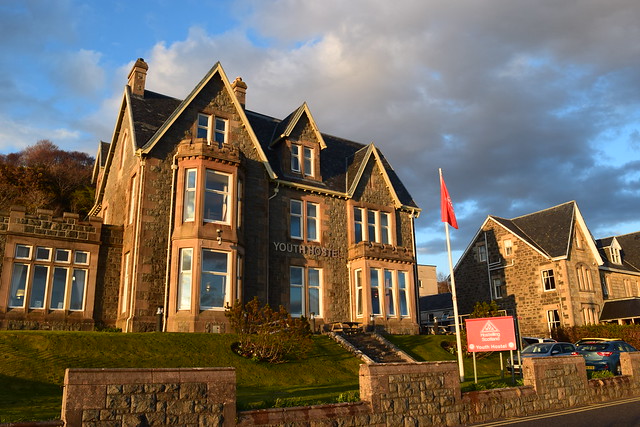
Oban Youth Hostel, Oban, Scotland
During our trip to Great Britain earlier in the year, we found reasonably priced accommodations for a family of four a little hard to come by. In order to keep accommodation costs down, we spent a few nights in hostels. This was a first for our family of four. We had our doubts as to how comfortable and safe we would feel, but our experiences were generally very positive.

Our very first stay in a hostel was just one night spent in the Oban Youth Hostel in Scotland. This hostel had 4-person rooms (two bunkbeds) with an en-suite bathroom which worked out very well for our first hostel experience. Sharing a bathroom with others was our biggest anxiety about staying in a hostel. The location along the waterfront and walking distance to the center of Oban is superb at this hostel though parking is limited. We brought take-out (Indian food of course) to eat in the kitchen/lounge. Afterwards, we took a walk by the water since dusk in May at this latitude isn't until after 9pm.
Untitled
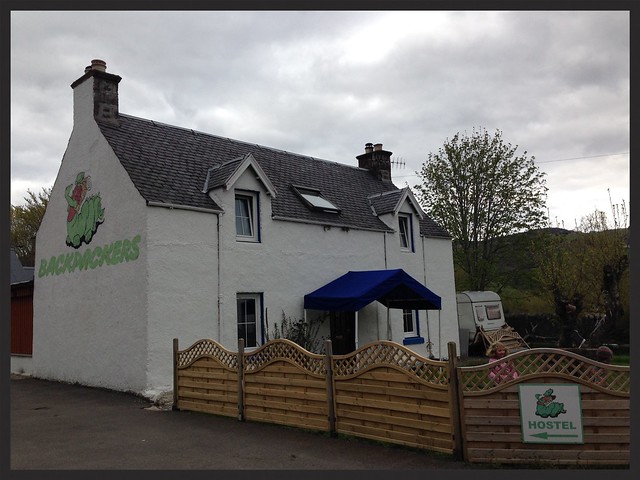
Loch Ness Backpacker's Lodge in Drumnadrochit, Scotland

Our second hostel experience was a bit different. We stayed two nights at the Loch Ness Backpacker's Lodge located minutes from Loch Ness and Urquhart Castle. This hostel has only two family rooms. Our room contained a full-size bed and bunk beds. The bathroom facilities at this location were shared with all the house guests. Fortunately, it was located right next to our room. I would have hated to traipse through the whole house in my pajamas every time I had to go to the bathroom. Still, it was odd to be taking a shower while an unfamiliar guest of the opposite sex brushed their teeth right outside the shower stall. Other than that bit of awkwardness, we had a pleasant experience. We were able to get some clothes washed for a nominal fee during our stay, and I had an enlightening conversation with a Scots and English couple about the impending elections.

Dorm 9 at YHA Oxford London
During the final days of our trip, we stayed three nights at YHA London Oxford Street before our departure. Here, we again had a 4-person room with two bunk beds. The bathroom situation was different from the other two because there were individual shower rooms with real doors and separate water closets to use a British term. All were just a few steps down the hallway and being separate facilities you never felt like you were "sharing" a facility at least not in the way they were shared at the Lock Ness Backpacker's Lodge. In addition, the staff at this facility were very helpful in getting us reduced tickets for bus tours and were invaluable in securing us a very early and inexpensive taxi to the airport for our return flights. The location near the Circus Oxford Station of the Underground is also a big plus.

When considering a family trip to the United Kingdom, don't rule out hostels. If you plan to stay at multiple hostels, you may want to consider membership in YHA or Hosteling International. With a YHA membership you are automatically made of a member of Hosteling International (HI). Membership gets you discounts on your stay as well as attractions and tours. Knowing a hostel is in the HI network gives peace of mind about cleanliness and safety. The Loch Ness Backpacker's Lodge is not in the HI network. We were in a pinch during those nights because of a 3-day weekend, however, I do not regret our stay there.

Keep in mind that not all hostels allow families. Hostels that do have accommodations for families can be more than adequate. The novelty of the accommodations can add to the family experience. For example, our children enjoyed sharing bunk beds with mom and dad and we appreciated the unexpected additional services not to mention the savings. So get out and go hosteling....

Friday, October 30, 2015

English Heritage Overseas Visitor Pass


Stonehenge April 2015
Are you planning a trip to England with plans of hitting three or more the the English Heritage Sites during your stay? If so, I highly recommend getting the English Heritage Overseas Visitor Pass. We saved about $100 by purchasing this pass.

Here is the breakdown of entry fees for a family of 2 adults with up to 3 children for each place we visited during our stay:
Old Sarum £12.20
Avebury £7.00 for parking; visiting the stones is free
Stonehenge a wapping £41.60
Carlisle Castle £17.40
Housesteads £19.00

We would have paid a total of £130.40 in entry fees for these stops which equals approximately $200 US. We paid half that for our Overseas Visitor Pass.

You can buy them online before you leave home or at one their staffed heritage sights. Proof of foreign residency is required. There are many heritage sites that are free but those may have parking fees. The more popular castles and manor houses as well as famous sites like Stonehenge and Hadrian's Wall have some pretty hefty entry fees. 

So, if you are planning a trip to England, save some money with the English Heritage Overseas Pass. And don't miss my post An American Driver in Great Britain for ideas on renting a car and driving during your stay. Cheerio!

Tuesday, August 18, 2015

Corbridge: A Roman Town

The last stop on our tour of Hadrian's Wall was the remains of Corbridge: A Roman Town. Corbridge is significant for several reasons - the most obvious being the easily discernible stratification of several eras of Roman construction.

During the Roman occupation of the the British Isles, forts were constructed to secure areas of conquest. However, there was a secondary benefit. Roman soldiers meant opportunities for trade. So villages would spring up outside the forts. This process was a convenient way to Romanize (or civilize) the occupied area. Corbridge became one of two successful Roman towns in the area around Hadrian's Wall (the other being Carlisle). While Corbridge was growing and inhabited right up to the end of the Roman occupation, there was very little development thereafter in contrast to Carlisle. The Roman remains there are buried beneath a castle and modern town. But Corbridge is surrounding by rural lands lending itself to much more extensive excavations. Therefore, the remains of at least four forts built one on top of the other are apparent followed by a large legionary supply base and a full-blown town. Subsidence of the upper layers shows is the first clue that the town was built on top of previous forts.
The undulation of the ground in the center reveals settling due to the underlying Roman construction
I believe this was a granary - ventilation kept out the wet and pests
Subterranean drainage system
Storage Room
The museum at Corbridge houses a variety of items uncovered in the area including Roman armor and other items found as part of the Corbridge Hoard and the Corbridge Lion which is believed to be a gravestone.
Hunt cup from Corbridge Roman Town
Corbridge Lion
See our tour of Hadrian's Wall on YouTube

Monday, July 13, 2015

An American Driver in Great Britain

DSC_0469

While planning our vacation to Great Britain, we considered traveling by train and by car. Being a family of four with two small children and given the distance we wanted to travel, it turned out to be much more economical to rent a car. And if you consider the freedom a car provides for exploring the countryside, our decision was simple.

We ended up reserving a car from Europcar at the Heathrow Airport. According to our sources in-country, car rentals are cheaper when renting from the airport as opposed to city centers. 

Europcar gave us a TomTom GPS with the rental. The Points of Interest (POI's) on TomTom's are, in our opinion, unreliable at best (we were reminded of this more than a few times on this trip!) With our cell coverage in the states, we can validate routes via google maps on our smartphones. But here in Great Britain, we found cell coverage to be much more sketchy between denser urban areas. It is possible our GiffGaff provider had something to do with that, nevertheless, an accurate, fully-functioning, dedicated GPS device can save you some frustration. 

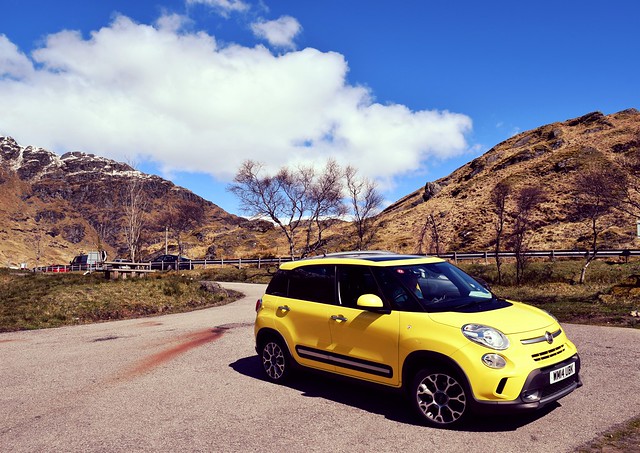
Regarding the car itself, we had our pick from a dozen or so available. As we perused the options before us, my eye was drawn to a yellow Fiat, not so much because of the color - though that turned out to be helpful - but because it had more big windows and sat up higher. In my mind, that made it a better choice for sightseeing. It wasn't until we were underway that I realized it also had a glass roof that opened. And the yellow color - well, if you are in an unfamiliar vehicle it is nice to have a nice bright color to help draw your eye when searching for it in a large carpark.

For Americans used to driving on the "right" side of the road, driving around Great Britain can be mind-boggling at times and not just because of driving on the left. It seems that most of the automobiles in Great Britain have standard transmissions. Rental cars with automatic transmissions cost twice as much as those with standard transmissions. So my beloved husband had to sit on the right and shift with his left hand. Fortunately, the gas, break and clutch pedals were in the same formation and the gears are oriented just as they are on an American car. So unless you are prepared to pay the price, American drivers must adjust to these changes and quickly.

British No Stopping sign
Simultaneously, American drivers must also familiarize themselves with unfamiliar signage and traffic patters. For instance, when you see this sign what would you think it means? Well, my first thought is that it means "STOP!" Don't go this way, etc. This can be very confusing as you negotiate your first roundabout on approach to a motorway onramp. As the caption states, in Great Britain this means no stopping.

And roundabouts are EVERYWHERE! Some look like normal roundabouts that you would see in the US. Then you have the roundabouts that are circles painted on the pavement sometimes not even a foot in diameter. So go around that bit of paint! - seriously! Every time you come to one of these you must treat it the same way as a "normal" roundabout. And then there is the double roundabout - I'm not even going to try to describe this! Note the sign in the following photo - and this one isn't even so bad. Once comfortable with these, the benefits of roundabouts become clear as traffic does keep flowing, but it takes some getting used to.
English: Sign for double roundabout at Faringt...
English: Sign for double roundabout at Farington. 'Model Farm' on right. (Photo credit: Wikipedia)
There are traffic lights at larger roundabouts and some pedestrian walkways. Instead of a changing from red to green to yellow, there the pattern is red, yellow, green, yellow. So you get an extra yellow to tell you to "proceed slowly" or "go cautiously" or "prepare to go" - I'm not sure - pick one. My chauffeur liked this change though.

When driving in the country, the challenges are a bit different. Many of the roads, particularly in Scotland are narrow and really not large enough for two cars to pass except at wider passing places. The roads are well-paved and there is good signage which keeps the experience from seeming entirely third-world. However, this sign makes the experience seem surreal:
English: National speed limit applies
English: National speed limit applies (Photo credit: Wikipedia)

Note the caption. The national speed limit in Great Britain for single carriageways is 60 miles per hour! Supposedly Brits are stuffy and conservative, when in fact they have legalized the game of chicken! Here is a video from one of our rural drives on a single carriageway northwest of Inverary in Scotland.


We did not meet an oncoming car in this instance but we did at other times. My very conscientious husband is going well below the 60 mph speed limit in anticipation.

If you are an American planning to rent a car for your travels in Great Britain, I hope this helps. Some bottom line reminders: drive on the left and look right before entering ANY roundabout. Safe travels!

Related Posts:

Wednesday, June 10, 2015

Chester's Roman Fort and Museum

Chester's Roman Fort and Museum is significant for the level of preservation of the fort and it's location along the picturesque River Tyne. The site contains the most complete remains of a Roman calvary fort and baths in Britain. The museum at Chester's contains a large collection of Roman artifacts the most significant of which are stone sculptures and inscriptions. Most of the artifacts in the museum were uncovered along the central section of Hadrian's wall by John Clayton (1792-1890), without whom, Chester's, in particular, and Hadrian's Wall, in general, would not be preserved and available to visitors today.
The bathhouse overlooking the Tyne River.
Roman Bathhouse as seen from the Tyne
Jonah and I enjoying the Sauna!
Extensive remains of the Roman Bathhouse at Chester's
Hadrian's Wall crossed the River Tyne here supported by a bridge
The walls in the main room of the museum are lined with sculptures and inscriptions mainly of a religious nature
The Edwardian era display of artifacts is significant in and of itself

Tuesday, May 19, 2015

Housesteads Roman Fort

The site of Housesteads Roman Fort and Museum
Due to its remote location, Housesteads, originally called Vercovicium, is the most well-preserved Roman Fort on Hadrian's Wall. It sits high on a hill on a break in the Whin Sill ridge near the very center of the wall (Castle Black, anyone?). Like all other Roman forts, this one was based on a standard design used throughout the Roman empire and included a barracks, granary, hospital, the commander's house, and the fort headquarters. This particular fort has the best preserved Roman latrines in all of Britain that still "flush" as designed. While all Roman forts had a decidedly Mediterranean style with central courtyards open to the sky, they made accommodations for the cool climate by designing radiant heating in the floors. Amazing! By the way, the 6-minute video housed in the small museum adjacent to the site is a must. It does a great job of succinctly describing how the fort was used and what it would have looked like when it was occupied by 800 Roman soldiers during it's heyday. 
The bases of columns are visible
The headquarters building in foreground with a view of the Northumbrian countryside in the background
Barracks once lined this avenue
Showing the design of radiant heated Roman floors.
The Roman latrine - wood bench seats would have lined the walls

Saturday, May 16, 2015

The Wall

An exploration of Hadrian's Wall could easily take several days even by car. It stretches more than 70 miles from one coast of Britain to the other - from Bowness-on-Solway to Wallsend near Newcastle-upon-Tyne. Construction took 15 years and began about 122AD under the direction of the Roman Emperor Hadrian. It averaged 18 feet in height and 9 feet thick, included 17 forts as well as smaller fortifications every mile called "milecastles," and signal turrets between each of these. Can you imagine the amount of manpower and stone required?! The official count is 18,000 soldiers and 4 million tons of stone. The cost of building such a thing in the modern age would likely be astronomical.

A definitive reason for the wall's construction is argued by historians, but some believe that Hadrian, having taken a tour of the empire, came to the very rational decision that continued expansion would further weaken the empire and that it would be better to fortify current borders rather than expand. There is archaeological evidence suggesting that some of the Northern Pictish tribes of Alba had experienced some success in attacking Roman forts north of the Solway-Tyne border at a time when Rome was experiencing rebellion and assault in other far flung corners of the empire. So, while at other times and under other rulers attempts were made by Rome to conquer the entire British Isle, Hadrian may have determined that the cost of doing so would outweigh the benefit. And so he built a wall.

Today, what remains of the wall is designated a UNESCO World Heritage Site. Several of the forts have been unearthed by archaeologists and onsite visitor centers and museums help guide visitors in understanding the history of the extensive ruins laid out before them. We took the better part of a day to visit just a few of these: Birdoswald Fort, Housesteads, Chesters, and Corbridge. If you'd rather follow the wall on foot you can do that as well. There is a path or trail that runs the length of the wall and is called Hadrian's Wall Path. This is one trail I would one day like to hike from beginning to end as the scenery of this entire region is spectacular.

One interesting aspect of traveling around Great Britain is all the places we encountered that are reminiscent of supposed fictional places described in some of the popular books that we've read, in particular Tolkein's The Lord of the Rings series and George R. R. Martin's Song of Ice and Fire series. The landscape of this entire area could easily be that of Rohan in Lord of the Rings which makes complete sense considering this entire area is in the Scottish Marches. As we stopped at sites along Hadrian's Wall, there were places where we could most definitely imagine this wall as the inspiration for "The Wall" in the Game of Thrones especially where it sits atop a steep, natural escarpment knows as The Whin Sill.
It is easy to understand why this is Great Britain's most popular tourist attraction and how this area has inspired many an author..


Wednesday, May 06, 2015

Hadrian's Wall: Birdoswald Fort

On the morning of our visit, we arrived at Birdoswald Fort before the interpretive area had opened. Nevertheless, we were able to see some stunning scenery of the wall and fort area.


Monday, May 04, 2015

Lanercost Priory: Photo Stop

This Augustinian priory in Cumbria was built in the 12th century. It was subject to frequent Scottish raids including attack by William Wallace and Robert Bruce. And King Edward I was a guest here on a number of occasions.

Wanting to get an early start on our day, we arrived at Lanercost Priory before it opened. While I would have loved to see inside and learn more, one can only see and do so much. This land is so full of history - when you arrive and find locked doors, one can simply drive a few miles down the road to another historical treasure. Since Hadrian's Wall is nearby, that is exactly what we did.

Exploring Carlisle Castle


Carlisle Castle has been continuously occupied since 1092 when first established by William II as the primary stronghold on England's NW border with Scotland. The site was previously a Roman turf and timber fort that garrisoned Hadrian's Wall and acted as a base for invasions into Scotland. 

Being on the border, Carlisle castle has a long sordid history making it the most besieged castle in Great Britain. It has been held by both English and Scottish kings and was the seat of the Warden of the West March during the 15th and 16th centuries in an effort to deal with Border Reivers. During the second Jacobite uprising of 1745-6, it was briefly held by Jacobites, and as recently as the 1970's the British Border Regiment was based here.


My little one was still feeling the effects of her tummy bug on our visit here, but we still managed to get a smile out of her. Here she is sitting on the foundation of the tower in which Mary Queen of Scots was held before being sent to London.
My 8 year old son was able to participate in some of the St. George Day activities. Here (video link) he is learning how to be an infantryman for the local lord.