After our stop at the Falkirk Wheel, we headed on to Stirling. By the time we had eaten a late lunch, the rain had let up and we decided to go ahead with a visit Stirling Castle. We only had a couple of hours before closing time, but since we'd already purchased a Scottish Heritage Pass it was still worth it. As it turns out, I enjoyed our tour of this castle more than the Edinburgh Castle. There were more nooks and crannies to explore devoid of people. The weather earlier in the day kept the tourists away, so, for the most part, it felt as if we had the place to ourselves. In addition, there was a great kid-friendly area in the lower recesses of one of the buildings with age appropriate exhibits and a dress-up area.
Like so many of the Scottish castles, Stirling Castle was built atop a rock promontory that dominates the surrounding area. The views from the castle are superb. We could easily see the William Wallace Monument (most Americans are familiar with him as the main character in Braveheart) and the spot on the river where he lead Scottish soldiers to victory over the British at Stirling Bridge.
After leaving the castle, we stopped for a brief walk around the Bannockburn battlefield and a statue of Robert the Bruce astride his armored steed. We ended our day in Stirling at Broomhall Castle: our first and only stay in a bed and breakfast during the entire trip. The beds were nice but the breakfast was hearty and delicious; I didn't know a traditional Scottish breakfast included mushrooms. Yum! We left there tanked up and ready for another day of driving and sightseeing.
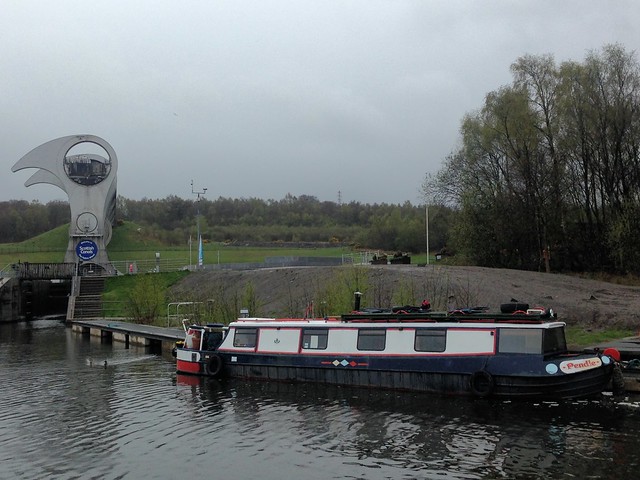
After only two nights in Edinburgh, we drove further north into Scotland on our way to Stirling. We decided to make a stop at the Falkirk Wheel - an ingeniously designed boat elevator linking the Forth and Clyde Canal to the Union Canal. This historic canal route was originally developed during the Industrial Revolution and connected Glascow with Edinburgh. By the 1930's the series of locks that connected the two canal were no longer functional. The current structure is a graceful mechanism for lowering and raising the boats the requisite 75 feet. Tourists can now tour the area by canal boat. Boats can be rented for multiple days and lived in like houseboats or other vacation homes.
Falkirk Wheel in Background with a canal boat in foreground
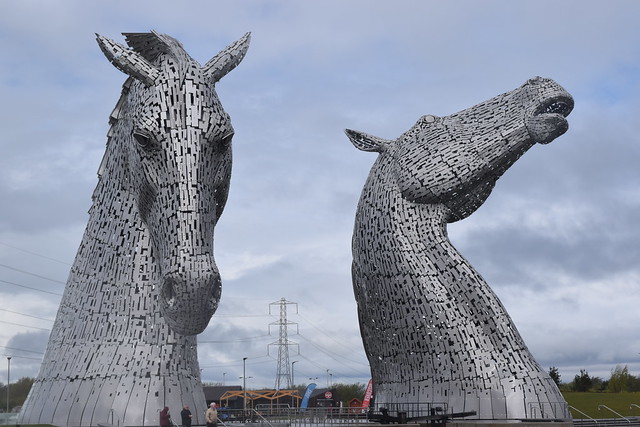
The Kelpies at the Helix
Very near the Falkirk Wheel are the Kelpies. We had never heard of these majestic horse head sculptures but saw them from afar. We couldn't help but to get a closer look - though we opted not to go inside.
On this day one year ago, we visited Edinburgh Castle. The castle, with it's restored interiors and sweeping views, is awe inspiring to say the least. There was so much to see from a Military Museum of the Royal Dragoons to the Scottish Crown Jewels and the Stone of Destiny.
All this wonderment came on the heals of a marvelously full day spent exploring the expansive ruins of Hadrians Wall, driving through Northumberland National Park, and our first views of ruined gothic abbeys.
We got a general feel for Edinburgh on the public bus ride to downtown. But other than the Sir Walter Scott Monument, which is hard to miss, we didn't take the time to see much else in Edinburgh. We finished up at the castle in the early afternoon and rode the bus back to our hotel. Needless to say, by this point we were ready to slow down a pace. So we drove to a mall for dinner and a movie - Avengers: Age of Ultron no less which was released a week early in the Great Britian. We all enjoyed the much needed respite before continuing north the next day on our driving tour of Scotland.
Location of Hadrian's Wall and the Antonine Wall in Scotland and Northern England. (Photo credit: Wikipedia)
A year ago today we were bundled up and occasionally getting pelted with sleet as we visited our first British Castle in Carlisle, Cumbria. We were introduced to the story of St. George and the dragon when our then 8 year old was able to participate in a reenactment of the story. This was also the first place we saw obvious indications of Roman occupation of this area. Stones from earlier Roman structures, including those inscribed with Latin, were used in the construction of Carlisle Castle.
However, it was on the following day that we really got a taste of the Romano-British era as we followed Hadrian's Wall on what was once a Roman road. We stopped at several major forts like Housesteads as well as smaller roadside mileforts along the route.
These couple of days were some of the most amazing and memorable. Of all the places we visited, this northernmost area of England is right up there with London in priority for a return visit. I would love to explore this area on foot one day.
On this day last year, we were on our way to Great Britain for the vacation of a lifetime. During those first few days, we visited historical sites the likes of which I had never before seen: Avebury, Stonehenge, and Old Sarum among them. We wore ourselves out trying to see and do as much as we could during our two weeks in-country. Our pace was exhausting, but it was so amazing! I will be taking time to reminisce over the next couple of weeks and sharing photos and videos that I just didn't get a chance to share last year.
We have had a long hot summer here in Central Florida this year. In the last week, Orlando had two separate days with record highs in the low 90s and that doesn't take into account the humidity. Needless to say, it has not felt like the holiday season is upon us which is a bummer. In order to allay my disappointment in this unseasonal weather, I intend to remind myself with this post of the wintry weather we experienced in April and May of this year while in Britain.
On our second day there, we noticed sleet hitting our jackets while visiting Carlisle Castle in the borderlands. The next day, en route from Hadrian's Wall to Edinburgh, we experienced snow in Northumberland National Park. We were so excited that we stopped the car to get out and let the snow fall on us. The weather was cool and crisp for the duration of our travels in Great Britain.
The climax of the wintry conditions however occurred in the middle of our trip when we found ourselves near Ben Nevis, the tallest peak in the British Isles. On a whim, we decided to ride the Gondola up to the snow line of the Nevis Mountain Range. The kids made snowballs and snow angels and even tried to bring snow home with them. We took a little hike out to a low peak at the worst possible time as the wind blew icy snow into our face. Poor Jonah was soaked through and nearly numb by the time we returned to the lodge to warm up with hot beverages. Looking out over the Great Glen, sipping coffee and hot chocolate is a memory we shouldn't soon forget.
This is not the only time we have experienced winter like conditions at an odd time of year. In 2013, we sold our house in North Carolina during the summer and headed north to Maine and Newfoundland with our RV. That year we experienced very cool weather during July through September (the hottest months here in Central Florida). We may just do that again next year, God willing.
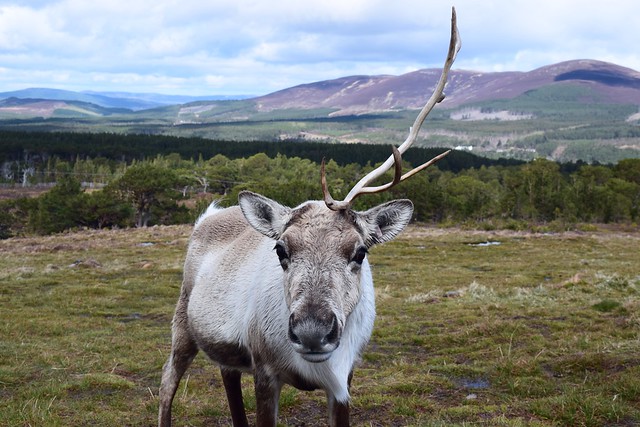
On our trip to Scotland, we were able to get up close to real, free-ranging reindeer in Cairngorms National Park. This was a great stop that we may have totally missed if not for seeing an episode of Travel with Kids in advance of our travels.
The Cairngorm Reindeer Herd consists of over 150 individuals that currently call the Cairngorms Mountains home. They were reintroduced to this area in 1952 by a Swedish Sami or Laplander named Mikel Utsi. For a fee, visitors can make a hill visit to feed and see the reindeer or for those with limited time or physical ability there is a quaint paddock at the Reindeer House where two or three are kept on rotation.
The last stop on our tour of Hadrian's Wall was the remains of Corbridge: A Roman Town. Corbridge is significant for several reasons - the most obvious being the easily discernible stratification of several eras of Roman construction.
During the Roman occupation of the the British Isles, forts were constructed to secure areas of conquest. However, there was a secondary benefit. Roman soldiers meant opportunities for trade. So villages would spring up outside the forts. This process was a convenient way to Romanize (or civilize) the occupied area. Corbridge became one of two successful Roman towns in the area around Hadrian's Wall (the other being Carlisle). While Corbridge was growing and inhabited right up to the end of the Roman occupation, there was very little development thereafter in contrast to Carlisle. The Roman remains there are buried beneath a castle and modern town. But Corbridge is surrounding by rural lands lending itself to much more extensive excavations. Therefore, the remains of at least four forts built one on top of the other are apparent followed by a large legionary supply base and a full-blown town. Subsidence of the upper layers shows is the first clue that the town was built on top of previous forts.
The undulation of the ground in the center reveals settling due to the underlying Roman construction
I believe this was a granary - ventilation kept out the wet and pests
Subterranean drainage system
Storage Room
The museum at Corbridge houses a variety of items uncovered in the area including Roman armor and other items found as part of the Corbridge Hoard and the Corbridge Lion which is believed to be a gravestone.
While planning our vacation to Great Britain, we considered traveling by train and by car. Being a family of four with two small children and given the distance we wanted to travel, it turned out to be much more economical to rent a car. And if you consider the freedom a car provides for exploring the countryside, our decision was simple.
We ended up reserving a car from Europcar at the Heathrow Airport. According to our sources in-country, car rentals are cheaper when renting from the airport as opposed to city centers.
Europcar gave us a TomTom GPS with the rental. The Points of Interest (POI's) on TomTom's are, in our opinion, unreliable at best (we were reminded of this more than a few times on this trip!) With our cell coverage in the states, we can validate routes via google maps on our smartphones. But here in Great Britain, we found cell coverage to be much more sketchy between denser urban areas. It is possible our GiffGaff provider had something to do with that, nevertheless, an accurate, fully-functioning, dedicated GPS device can save you some frustration.
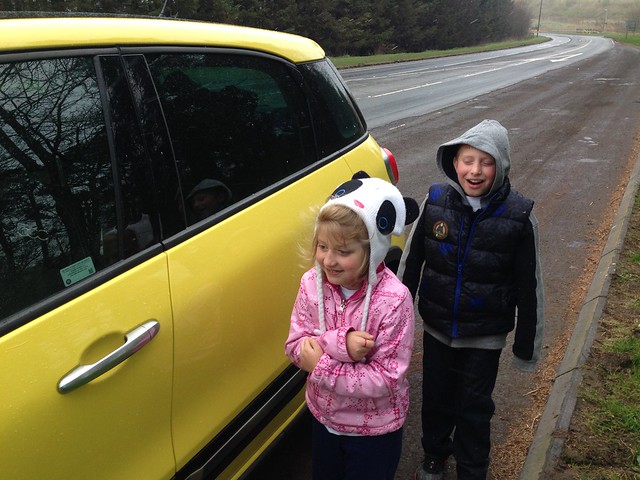
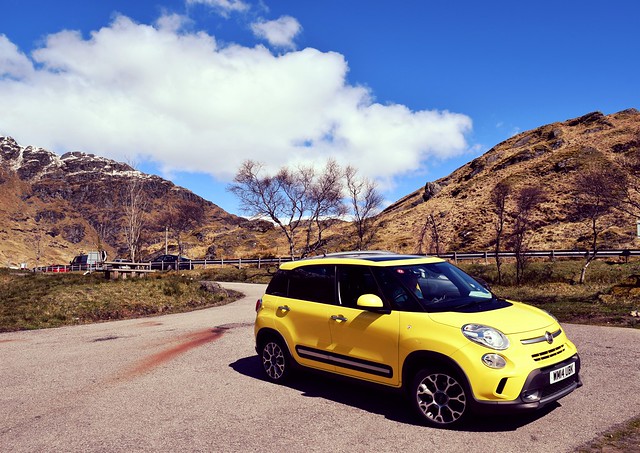
Regarding the car itself, we had our pick from a dozen or so available. As we perused the options before us, my eye was drawn to a yellow Fiat, not so much because of the color - though that turned out to be helpful - but because it had more big windows and sat up higher. In my mind, that made it a better choice for sightseeing. It wasn't until we were underway that I realized it also had a glass roof that opened. And the yellow color - well, if you are in an unfamiliar vehicle it is nice to have a nice bright color to help draw your eye when searching for it in a large carpark.
For Americans used to driving on the "right" side of the road, driving around Great Britain can be mind-boggling at times and not just because of driving on the left. It seems that most of the automobiles in Great Britain have standard transmissions. Rental cars with automatic transmissions cost twice as much as those with standard transmissions. So my beloved husband had to sit on the right and shift with his left hand. Fortunately, the gas, break and clutch pedals were in the same formation and the gears are oriented just as they are on an American car. So unless you are prepared to pay the price, American drivers must adjust to these changes and quickly.
Simultaneously, American drivers must also familiarize themselves with unfamiliar signage and traffic patters. For instance, when you see this sign what would you think it means? Well, my first thought is that it means "STOP!" Don't go this way, etc. This can be very confusing as you negotiate your first roundabout on approach to a motorway onramp. As the caption states, in Great Britain this means no stopping.
And roundabouts are EVERYWHERE! Some look like normal roundabouts that you would see in the US. Then you have the roundabouts that are circles painted on the pavement sometimes not even a foot in diameter. So go around that bit of paint! - seriously! Every time you come to one of these you must treat it the same way as a "normal" roundabout. And then there is the double roundabout - I'm not even going to try to describe this! Note the sign in the following photo - and this one isn't even so bad. Once comfortable with these, the benefits of roundabouts become clear as traffic does keep flowing, but it takes some getting used to.
English: Sign for double roundabout at Farington. 'Model Farm' on right. (Photo credit: Wikipedia)
There are traffic lights at larger roundabouts and some pedestrian walkways. Instead of a changing from red to green to yellow, there the pattern is red, yellow, green, yellow. So you get an extra yellow to tell you to "proceed slowly" or "go cautiously" or "prepare to go" - I'm not sure - pick one. My chauffeur liked this change though.
When driving in the country, the challenges are a bit different. Many of the roads, particularly in Scotland are narrow and really not large enough for two cars to pass except at wider passing places. The roads are well-paved and there is good signage which keeps the experience from seeming entirely third-world. However, this sign makes the experience seem surreal:
English: National speed limit applies (Photo credit: Wikipedia)
Note the caption. The national speed limit in Great Britain for single carriageways is 60 miles per hour! Supposedly Brits are stuffy and conservative, when in fact they have legalized the game of chicken! Here is a video from one of our rural drives on a single carriageway northwest of Inverary in Scotland.
We did not meet an oncoming car in this instance but we did at other times. My very conscientious husband is going well below the 60 mph speed limit in anticipation.
If you are an American planning to rent a car for your travels in Great Britain, I hope this helps. Some bottom line reminders: drive on the left and look right before entering ANY roundabout. Safe travels!
Melrose Abbey was established 1136 by King David I of Scotland. It was destroyed and rebuilt several times in the struggle between Scotland and England. The spectacular ruins that survive today dates from the 1400's. The elaborate designs that include sculptures of saints, gargoyles and plants that grace the ruinous halls and walls add to the visual appeal of this sacred place. Several Scottish Kings are buried here and it is believed that the heart of Robert the Bruce is also interred here.
Melrose Abbey with Burial Marker for Robert the Bruce's Heart in the foreground
View from the southwest
Side view of the southern transept and nave
Steps to the bell tower
Bagpipe playing pig
The view of the choir area from the bell tower
Gargoyles and saints stare out from the walls
The ceiling of the nave
Ornate leaf patterns decorate the interior supports
The memorial marker locating the reburial of the supposed heart of Robert the Bruce.
Chester's Roman Fort and Museum is significant for the level of preservation of the fort and it's location along the picturesque River Tyne. The site contains the most complete remains of a Roman calvary fort and baths in Britain. The museum at Chester's contains a large collection of Roman artifacts the most significant of which are stone sculptures and inscriptions. Most of the artifacts in the museum were uncovered along the central section of Hadrian's wall by John Clayton (1792-1890), without whom, Chester's, in particular, and Hadrian's Wall, in general, would not be preserved and available to visitors today.
Due to its remote location, Housesteads, originally called Vercovicium, is the most well-preserved Roman Fort on Hadrian's Wall. It sits high on a hill on a break in the Whin Sill ridge near the very center of the wall (Castle Black, anyone?). Like all other Roman forts, this one was based on a standard design used throughout the Roman empire and included a barracks, granary, hospital, the commander's house, and the fort headquarters. This particular fort has the best preserved Roman latrines in all of Britain that still "flush" as designed. While all Roman forts had a decidedly Mediterranean style with central courtyards open to the sky, they made accommodations for the cool climate by designing radiant heating in the floors. Amazing! By the way, the 6-minute video housed in the small museum adjacent to the site is a must. It does a great job of succinctly describing how the fort was used and what it would have looked like when it was occupied by 800 Roman soldiers during it's heyday.
The bases of columns are visible
The headquarters building in foreground with a view of the Northumbrian countryside in the background
Barracks once lined this avenue
Showing the design of radiant heated Roman floors.
The Roman latrine - wood bench seats would have lined the walls
 After our stop at the Falkirk Wheel, we headed on to Stirling. By the time we had eaten a late lunch, the rain had let up and we decided to go ahead with a visit Stirling Castle. We only had a couple of hours before closing time, but since we'd already purchased a Scottish Heritage Pass it was still worth it. As it turns out, I enjoyed our tour of this castle more than the Edinburgh Castle. There were more nooks and crannies to explore devoid of people. The weather earlier in the day kept the tourists away, so, for the most part, it felt as if we had the place to ourselves. In addition, there was a great kid-friendly area in the lower recesses of one of the buildings with age appropriate exhibits and a dress-up area.